
NAT Gateway and NAT Instance – Enabling Secure Outbound Connectivity in the Cloud




In modern cloud architectures, enabling secure and controlled outbound internet access for private resources is a common requirement. Two widely used solutions offered by cloud providers to achieve this are NAT Gateways and NAT Instances. Both serve the core function of Network Address Translation (NAT), allowing resources within private subnets to initiate outbound connections to the internet while remaining unreachable from the outside, but differ in terms of scalability, automation, cost-efficiency, and operational overhead. Choosing the right approach depends on your specific networking needs, security requirements, and budget constraints.
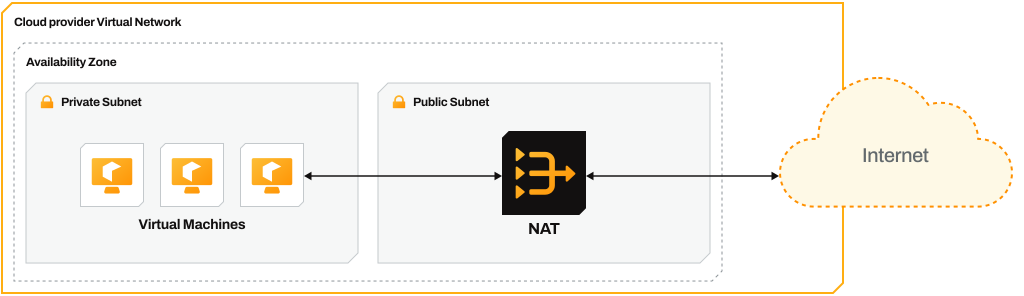
NAT Gateway
A NAT Gateway is a fully-managed, scalable, and high-availability service provided by cloud vendors. It allows outbound internet traffic from private instances while preventing unsolicited inbound connections. NAT Gateways are typically deployed in public subnets and are linked to route tables that govern private subnet traffic.
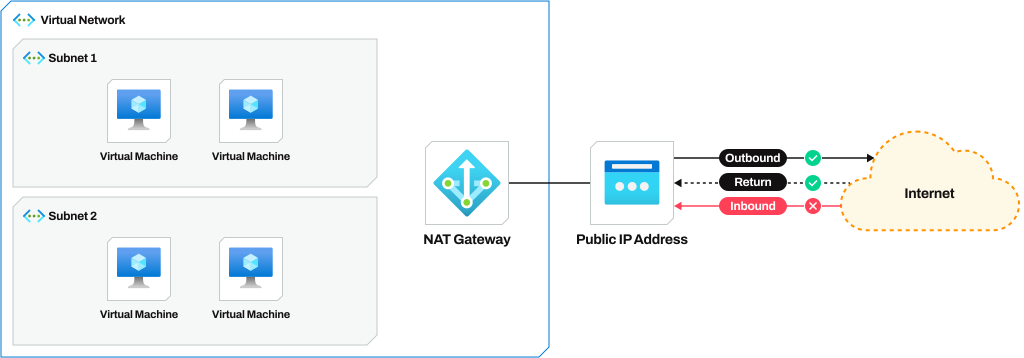
Use Case
Ideal for enterprises seeking zero operational overhead, high performance, and automated scaling for NAT traffic, especially in production environments.
Advantages of NAT Gateway
Advantages of NAT Instance

Fully managed
No need to configure or maintain OS-level settings

Scalability
Automatically scales with traffic volume

High Availability
High availability by design (per availability zone)

Cloud Integration
Integrated with cloud-native monitoring and billing tools
NAT Gateway and NAT Instance – Enabling Secure Outbound Connectivity in the Cloud
 Download Solution Brief
NAT Gateway
A NAT Instance is a virtual machine configured to perform NAT functions manually. Unlike a NAT Gateway, this approach requires the user to configure and manage routing, firewall rules, and OS-level NAT features. NAT Instances offer greater flexibility and control.
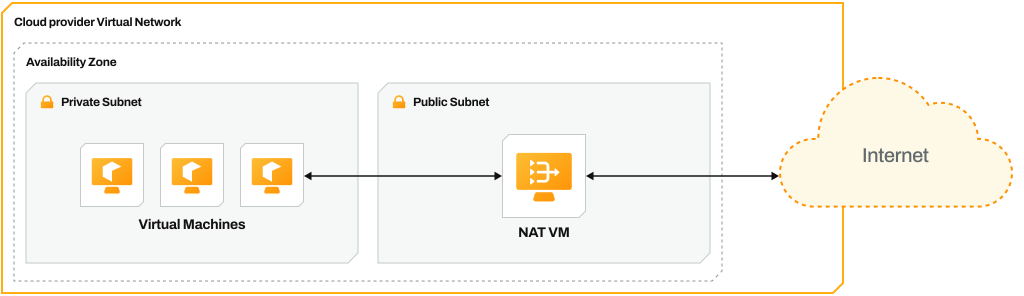
Use Case
Best suited for environments that require custom traffic policies, deep packet inspection, logging, or cost optimization for medium to large-scale traffic.
Advantages of NAT Instance

Full Control
Full control over the OS and network stack

Customizable
Ability to run custom software (e.g., DPI, monitoring agents)

Cost Effective
Can be more cost-effective in high-traffic scenarios

Flexibility
Flexibility in choosing instance type, size, and features


Want to learn more about VyOS Technical Capabilities?
Download the Technical Datasheet

 Technical Datasheet
Advantages of Using VyOS as a NAT Instance
VyOS is an open-source network OS that provides advanced routing, firewall, and NAT functionality. When used as a NAT instance in cloud environments, VyOS offers several benefits over generic Linux-based NAT setups:

Enterprise-grade features
Advanced NAT, firewall, QoS, and VPN capabilities in a unified platform
Customizable and lightweight
Tailored images for cloud providers with minimal overhead
Consistent experience
The same CLI and behavior across cloud and on-prem environments simplifies hybrid deployments
Configuration as code
All configuration is text-based and fully automatable (via CLI or API), ideal for infrastructure-as-code pipelines
Persistent configuration
Unlike some traditional VMs, VyOS ensures config survives reboots and is easy to version-control
Strong community and support options
Commercial support is available, and the open-source community is active

Resources
Here are some resources to help you learn more about VyOS, keep up with the development, and participate in it.


