




What is Data Center Interconnect (DCI)?
Data Center Interconnect (DCI) refers to the technologies and architectures used to connect two or more geographically separated data centers, allowing them to operate as a unified environment. DCI is essential for ensuring business continuity, disaster recovery, workload mobility, multi-site clustering, and hybrid/multi-cloud integration.
DCI enables seamless exchange of data, synchronization of applications, replication of storage, and migration of virtual machines or containers between sites with high performance and low latency.
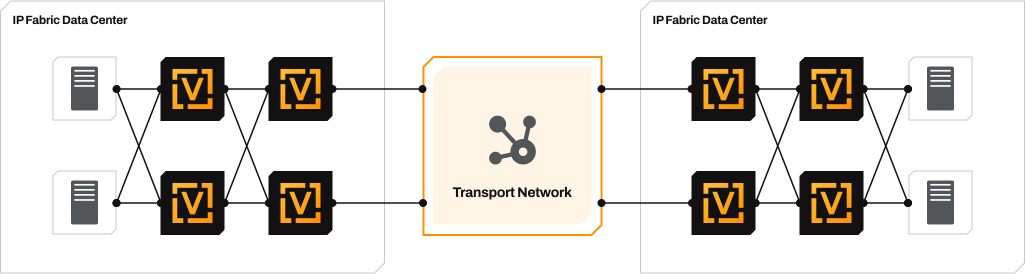
Datacenter Interconnect (DCI) - Solution Brief
 Download Solution Brief
Communication Methods for DCI
Depending on the use case and network design, DCI can operate at different layers of the OSI model:
1. LAYER 2 DCI (L2 DCI)
- Extends VLANs across sites to allow Layer 2 adjacency.
- Supports live VM migration (e.g., vMotion), MAC mobility, and broadcast domain extension.
- Technologies: VXLAN, EVPN, VPLS, OTV, QinQ.
2. LAYER 3 DCI (L3 DCI)
- Interconnects sites via IP routing, supporting isolated domains with routed connectivity.
- Better scalability and fault isolation.
- Technologies: BGP, MPLS, Segment Routing, IPsec tunnels.
3. HYBRID L2/L3 DCI
- Combines Layer 2 extension for some workloads with Layer 3 routing for others.
- Offers flexibility in mixed environments or during migration phases.
- Common in EVPN-based VXLAN fabrics.


Want to learn more about VyOS Technical Capabilities?
Download the Technical Datasheet

 Technical Datasheet
Transport Options for DCI
DCI can be implemented over various physical or virtual transport networks, depending on distance, performance, security, and cost requirements:
Private Fiber (Dark Fiber)
 Offers full control, ultra-low latency, and high bandwidth.
- Ideal for metro or campus-level DCI.
- Can carry multiple services (e.g., DWDM, Ethernet, Fibre Channel).
Wavelength Services (WDM/DWDM)
- Optical multiplexing for high-capacity links.
- Provided by service providers as managed wavelength circuits.
MPLS (Layer 2 or Layer 3 VPNs)
- Carrier-grade transport for regional or global connectivity.
- Supports QoS, traffic engineering, and segmentation.
IPsec or MACsec over Internet/Public Networks
- Encrypted tunnels for secure data exchange over less trusted transport.
- Cost-effective, especially for remote or hybrid-cloud DCI.
Carrier Ethernet / Metro Ethernet
- Ethernet-based service provided by ISPs.
- Suitable for low to medium distances with predictable SLAs.
Cloud Interconnect Services
- Native DCI offerings from cloud providers (e.g., AWS Direct Connect, Azure ExpressRoute, Google Cloud Interconnect).
- Used for hybrid and multi-cloud DCI strategies.
DCI Options for VxLAN with EVPN Signaling
When VXLAN is used with EVPN as the control plane, DCI can be implemented in a more scalable and structured way. The main options for interconnecting VXLAN-EVPN fabrics across data centers are:
EVPN Control Plane Extension Across Sites (Global BGP EVPN)
- A single BGP EVPN control plane spans multiple data centers.
- All VTEPs from both sites participate in the same EVPN instance.
- Full MAC/IP mobility is supported across data centers.
- Requires L3 underlay connectivity between sites.
- Typically used when data centers are close (e.g., metro DCI with low latency).
EVPN Interconnect via Route Reflectors or Border Leaf Nodes
- EVPN Interconnect via Route Reflectors or Border Leaf Nodes
- Separate EVPN domains per site, interconnected via EVPN route reflectors or inter-site gateways.
- Border Leaf nodes (or DCI gateways) import/export EVPN routes between fabrics.
- Offers more control and fault domain isolation.
- Supports stretched services (e.g., same VNI across sites) and L3 segmentation.
EVPN Overlay with L3 Gateway at the Border
- EVPN Overlay with L3 Gateway at the Border
- Each site runs its own EVPN-VXLAN fabric.
- Inter-site communication happens via L3 routing (BGP/OSPF) at the fabric edge.
- VNI domains are independent; no L2 stretch.
- Best for active-active multi-site designs where L2 extension is not required.
EVPN-VxLAN with MPLS DCI (EVPN-MPLS Interworking)
- EVPN-VxLAN with MPLS DCI (EVPN-MPLS Interworking)
- Use EVPN over VXLAN inside the DC and EVPN over MPLS in the WAN/DCI.
- Border gateways perform encapsulation/decapsulation between VXLAN and MPLS.
- Suitable for service provider environments or large enterprises with MPLS WANs.
Resources
Here are some resources to help you learn more about VyOS, keep up with the development, and participate in it.


