
Cloud-ready data centers with EVPN+VXLAN
The Foundation for Next-Gen Data Center and Campus Networks




EVPN + VxLAN
EVPN-VXLAN is a modern network overlay technology that combines Ethernet VPN (EVPN) with Virtual Extensible LAN (VXLAN) to deliver scalable, flexible, and efficient Layer 2 and Layer 3 connectivity across data centers and cloud environments. It’s the foundation for building next-generation data center fabrics, enabling seamless multi-tenancy, workload mobility, and network segmentation across large-scale infrastructures.
By decoupling the physical network from the logical topology, EVPN-VXLAN allows operators to design agile, programmable, and highly resilient architectures that are ideal for cloud-native applications, virtualization, and hybrid cloud deployments.
Key Benefits of EVPN-VxLAN
Enable seamless connectivity and security across your enterprise with VyOS EVPN-VxLAN

Scalability
Supports massive growth in tenants and endpoints using VXLAN’s 24-bit VNIs, far exceeding traditional VLAN limits.

Multi-Tenancy
Isolates traffic for different customers or applications, ensuring secure segmentation in shared infrastructures.

Layer 2 and Layer 3 Connectivity
Offers integrated support for both L2 bridging and L3 routing services across distributed environments.

Efficient MAC Learning
Uses control-plane-based MAC distribution (via BGP EVPN), avoiding flooding and reducing unnecessary traffic.

Mobility and Flexibility
Enables seamless VM or container mobility across data centers without breaking network sessions.

Resilient and Redundant
Supports active-active multihoming and fast convergence for high availability.

Cloud-Ready
Ideal for SDN and cloud environments, with native support for automation, programmability, and service chaining.
How EVPN-VxLAN Works
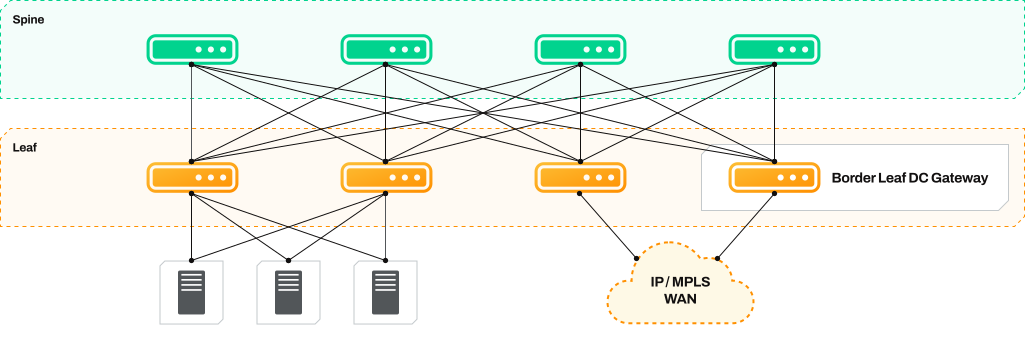
EVPN-VXLAN overlays a virtual network on top of an IP-based underlay. VXLAN encapsulates Ethernet frames into UDP packets, enabling Layer 2 networks to be extended over Layer 3 infrastructures. Each VXLAN segment is identified by a VXLAN Network Identifier (VNI), allowing isolation between tenants or services.
The EVPN control plane, based on BGP, distributes MAC address and IP-to-MAC mapping information between network devices (usually called VXLAN Tunnel Endpoints or VTEPs). This eliminates the need for traditional flooding and learning methods, making the network more efficient and deterministic.
VTEPs encapsulate and de-encapsulate VXLAN traffic, ensuring traffic is sent only to the intended recipients. With EVPN, the network can support advanced features like IRB (Integrated Routing and Bridging), ARP suppression, and active-active multihoming, bringing cloud-scale networking capabilities to enterprise and service provider environments.
Cloud-ready data centers with EVPN+VXLAN
 Download Solution Brief
EVPN-VxLAN for Data Centers
Key Benefits of EVPN-VxLAN
EVPN-VXLAN has become the de facto standard for building scalable, agile, and cloud-ready data center fabrics. It addresses the limitations of traditional Layer 2 networks and provides a robust foundation for multi-tenant architectures, workload mobility, and automation-driven operations.

Scalable Layer 2 Over Layer 3 Fabric
By decoupling Layer 2 connectivity from the physical topology, EVPN-VXLAN enables seamless extension of broadcast domains over a Layer 3 underlay. This supports scalable east-west traffic patterns without compromising performance or manageability.

Massive Multi-Tenancy Support
Using VXLAN Network Identifiers (VNIs) and EVPN route types, data centers can support thousands of isolated tenants or services within a single fabric—ideal for service providers, cloud operators, and large enterprises.

Workload Mobility and Elasticity
EVPN-VXLAN enables VMs, containers, and services to move freely across racks or sites without changing IP addresses. This ensures business continuity and simplifies disaster recovery and active-active site designs.

Integrated Layer 2 and Layer 3 Services
With Integrated Routing and Bridging (IRB), EVPN-VXLAN provides efficient L2 and L3 connectivity at the network edge, reducing latency and simplifying network design while maintaining optimal traffic flow.

Optimized Traffic Handling
EVPN’s control-plane-based MAC and ARP learning eliminates the need for flooding, improving bandwidth efficiency and lowering CPU usage on switches.

High Availability and Resilience
With native support for active-active multihoming, fast convergence, and loop prevention, EVPN-VXLAN ensures data center services remain uninterrupted and resilient to failures or link changes.

Automation and SDN Readiness
Designed for modern infrastructure, EVPN-VXLAN integrates easily with network automation tools (like Ansible, Terraform) and SDN controllers, streamlining provisioning and reducing operational errors.

Seamless Hybrid and Multi-Cloud Connectivity
By extending overlay networks across physical and virtual environments, EVPN-VXLAN simplifies the integration between private data centers and public clouds—accelerating hybrid cloud adoption.
EVPN-VxLAN vs. Traditional Data Center Networks
Feature
Traditional L2/L3 Network
EVPN-VxLAN Fabric
Scalability
Limited to ~4K VLANs
Supports 16 million VNIs
Layer 2 Extension
Spanning Tree Protocol (STP), prone to loops
VXLAN tunnels with loop-free Layer 3 underlay
Traffic Learning
Flood-and-learn
Control-plane-based MAC learning (BGP EVPN)
Multitenancy
Complex with VRFs and VLANs
Simplified with EVPN route types and VNIs
Workload Mobility
Limited, breaks L3 session continuity
Seamless with distributed gateways
High Availability
Active/standby links, slower convergence
Active/active multihoming, fast convergence
Automation
Manual, CLI-driven
Fully automatable with SDN and IaC tools
Hybrid Cloud Integration
Manual setup, limited flexibility
Native overlay extension into cloud


Want to learn more about VyOS Technical Capabilities?
Download the Technical Datasheet

 Technical Datasheet
L2VPN EVPN VXLAN Deployment Guide.
L3VPN EVPN VXLAN Deployment Guide
Resources
Here are some resources to help you learn more about VyOS, keep up with the development, and participate in it.


