
EVPN-VXLAN for Enterprise Campus




EVPN + VxLAN
EVPN-VXLAN is a modern network overlay technology that combines Ethernet VPN (EVPN) with Virtual Extensible LAN (VXLAN) to deliver scalable, flexible, and efficient Layer 2 and Layer 3 connectivity across data centers and cloud environments. It’s the foundation for building next-generation data center fabrics, enabling seamless multi-tenancy, workload mobility, and network segmentation across large-scale infrastructures.
By decoupling the physical network from the logical topology, EVPN-VXLAN allows operators to design agile, programmable, and highly resilient architectures that are ideal for cloud-native applications, virtualization, and hybrid cloud deployments.
Key Benefits of EVPN-VxLAN
Enable seamless connectivity and security across your enterprise with VyOS EVPN-VxLAN

Scalability
Supports massive growth in tenants and endpoints using VXLAN’s 24-bit VNIs, far exceeding traditional VLAN limits.

Multi-Tenancy
Isolates traffic for different customers or applications, ensuring secure segmentation in shared infrastructures.

Layer 2 and Layer 3 Connectivity
Offers integrated support for both L2 bridging and L3 routing services across distributed environments.

Efficient MAC Learning
Uses control-plane-based MAC distribution (via BGP EVPN), avoiding flooding and reducing unnecessary traffic.

Mobility and Flexibility
Enables seamless VM or container mobility across data centers without breaking network sessions.

Resilient and Redundant
Supports active-active multihoming and fast convergence for high availability.

Cloud-Ready
Ideal for SDN and cloud environments, with native support for automation, programmability, and service chaining.
How EVPN-VxLAN Works
EVPN-VXLAN overlays a virtual network on top of an IP-based underlay. VXLAN encapsulates Ethernet frames into UDP packets, enabling Layer 2 networks to be extended over Layer 3 infrastructures. Each VXLAN segment is identified by a VXLAN Network Identifier (VNI), allowing isolation between tenants or services.
The EVPN control plane, based on BGP, distributes MAC address and IP-to-MAC mapping information between network devices (usually called VXLAN Tunnel Endpoints or VTEPs). This eliminates the need for traditional flooding and learning methods, making the network more efficient and deterministic.
VTEPs encapsulate and de-encapsulate VXLAN traffic, ensuring traffic is sent only to the intended recipients. With EVPN, the network can support advanced features like IRB (Integrated Routing and Bridging), ARP suppression, and active-active multihoming, bringing cloud-scale networking capabilities to enterprise and service provider environments.
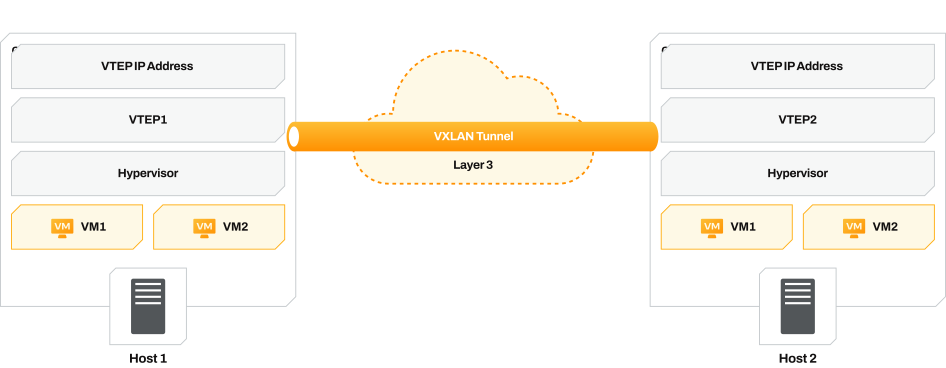
Cloud-ready data centers with EVPN+VXLAN
 Download Solution Brief
EVPN-VXLAN for Enterprise Campus
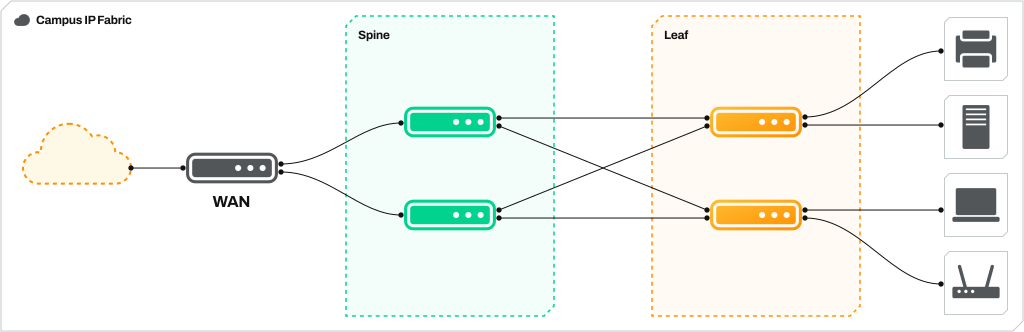
Key Benefits of EVPN-VxLAN
Implementing EVPN-VXLAN in an enterprise campus transforms the traditional network architecture into a modern, scalable, and service-oriented fabric. It brings cloud-scale technologies to the campus, enabling agility, automation, and operational efficiency. Here's how enterprises benefit:

Unified Layer 2/Layer 3 Fabric
EVPN-VXLAN enables a consistent, scalable Layer 2 and Layer 3 fabric across the entire campus. It simplifies network segmentation and routing, allowing seamless communication between users, devices, and applications, regardless of their physical location.

Secure Network Segmentation
Through the use of VXLAN Network Identifiers (VNIs) and EVPN route types, enterprises can create isolated segments (micro-segmentation) for departments, applications, or user roles—enhancing security and reducing the attack surface.

Scalability and Flexibility
VXLAN overcomes VLAN scalability limitations, supporting thousands of segments across the campus. This enables future growth and simplifies integration with data center and cloud environments.

Seamless User and Device Mobility
EVPN-VXLAN supports consistent policies and connectivity for roaming users and devices across different access switches and campus buildings, thanks to distributed gateways and integrated Layer 3 routing.

High Availability and Fast Convergence
With active-active multihoming, control-plane-based MAC learning, and loop-free topologies, EVPN-VXLAN delivers resilient connectivity and faster convergence during network changes or failures.

Network Automation and Operational Simplicity
EVPN-VXLAN aligns with modern automation frameworks (e.g., NetConf, Ansible, Terraform), allowing enterprises to deploy and manage campus networks with greater speed, accuracy, and visibility.

Cloud and SDN Integration
By adopting EVPN-VXLAN, enterprises build a campus network that is cloud-ready and compatible with software-defined networking (SDN), paving the way for future integrations with hybrid or multi-cloud strategies.
EVPN-VxLAN vs. Traditional Campus Network Design
EVPN-VXLAN modernizes the campus network by eliminating the limitations of legacy L2 protocols, enabling faster convergence, seamless mobility, and cloud-native operations. It provides a unified architecture that bridges the gap between the enterprise campus and modern data center or cloud environments.


Want to learn more about VyOS Technical Capabilities?
Download the Technical Datasheet

 Technical Datasheet
L2VPN EVPN VXLAN Deployment Guide
L3VPN EVPN VXLAN Deployment Guide
Resources
Here are some resources to help you learn more about VyOS, keep up with the development, and participate in it.


