
ISP Border Router Secure, scalable gateways for global connectivity




Introduction
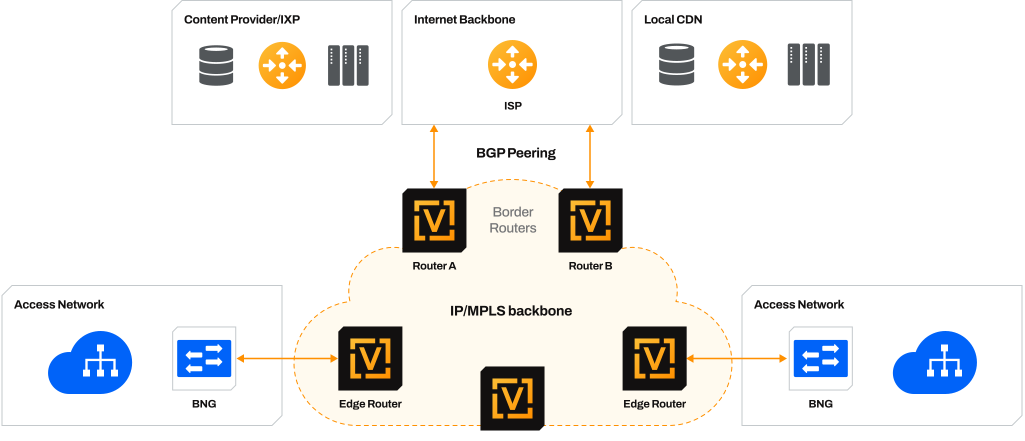
An ISP border router is a critical component of the service provider’s infrastructure. It connects the ISP’s internal network (core or aggregation layer) to external networks such as other ISPs, internet exchanges (IXPs), and content providers. Therefore, it must be highly reliable, scalable, and feature-rich.
Understanding these critical challenges some points should be taken into consideration when choosing the right border routing platform to ensure it delivers crucial features and functions like support for a full internet routing table, RPKI, policies for filtering and traffic management, QoS, NAT, mainstream routing protocols like BGP, OSPF, IS-IS and device management.
Key features

High Performance
Capable of handling high volumes of traffic with low latency and high packets-per-second (PPS) performance.

Scalability
Support for large routing and forwarding tables (millions of routes), essential for full BGP internet routing.

High Availability
Features for Fast Convergence, Graceful Restart and BFD (Bidirectional Forwarding Detection).

Policy Control
Support for route maps, prefix-lists, community-based filtering, and BGP policy controls for fine-grained traffic engineering and peering policies.

Load Balancing
ECMP (Equal-Cost Multi-Path), MPLS and SR (Segment Routing) for integration to the backbone network.

Security Features
Support for infrastructure ACLs, RPKI-based route origin validation and BGP session protection (TTL Security, MD5 authentication).

Multiservice Support
Ability to support IPv4 and IPv6 natively (dual-stack), multicast, MPLS VPNs (Layer 2 & 3), and QoS features for service differentiation.
VyOS can serve as an ISP border router, as it supports all the essential features required for this role—offering a flexible and reliable solution to meet the demands of any type of ISP network.
VyOS is fully equipped to operate as an ISP border router, delivering the critical capabilities needed to handle the complex requirements of modern service provider networks—regardless of their size or architecture.
Replace old hardware border routers with VyOS virtual solutions
 Download Solution Brief
Core Functionalities

Traffic Balancing
Splitting and balancing traffic between multiple links optimize not only packet flow, latency and connectivity, but also gives you a fine control over your data flow into external connections. With BGP inside VyOS you can control connectivity to external networks by managing your network visibility, filtering announcements and marking routes with dedicated groups for easier management.

Portability
If you need an additional router, you can deploy one on almost any device with 64-bit x86 CPU, without having to obtain specific hardware. The productivity and performance of current microprocessors are growing rapidly, leading to constant appearance of new and more powerful devices at lower costs. Thus, such devices become increasingly more available, allowing you to speed up your router with small investments without having to alter the software.

Dynamic Internal Routing
Border gateway needs not only the ability to peer with autonomous external systems but also effectively route traffic between internal routers. VyOS supports OSPFv2/v, IS-IS as well as MPLS, LDP and segment routing to keep routing ans transport for both IPv4 and IPv6 resources under control.

Reliable Connectivity
ISPs are transit points for many users’ traffic and keeping them online at all times is an absolute top-priority task. Usually, this is done by providing multiple paths to the same resources on the internet that VyOS accomplishes by means of dynamic BGP routing or static load-balancing with automated failover.

High Availability
Even the most durable routing solutions can’t ensure 100% uptime. To avoid troubles with a single point of failure, VyOS provides the ability to build multi-routers topologies with VRRP. You can always be prepared to face an unexpected problem and conduct maintenance in peace.
Supported Protocols
Comprehensive Support for Industry-Standard Routing Protocols
INTERIOR GATEWAY PROTOCOLS
- OSPFv2 / OSPFv3
- IS-IS
- RIP / RIPng
EXTERIOR GATEWAY PROTOCOL
- BGP (iBGP and eBGP) – Core protocol for internet and inter-AS routing
- Full IPv4 and IPv6 support
- Support for BGP communities, route reflectors, confederations
- Graceful Restart and BGP Add-Path
- RPKI and BGP Flowspec
TUNNELING AND MPLS
- MPLS / RSVP-TE / LDP / SR-MPLS / SRv6
- GRE / IPsec / VXLAN (For overlay connectivity or secure tunnels)
ROUTING POLICIES & FILTERING
- Prefix-lists, route-maps, communities, extended communities, AS-path filters, etc.
MONITORING AND MANAGEMENT
- NetFlow / sFlow / IPFIX
- SNMP
- Syslog, BGP monitoring protocols (BMP)
SECURITY PROTOCOLS
- RPKI (Resource Public Key Infrastructure)
- BGP MD5, TTL Security
- ACLs


Want to learn more about VyOS Technical Capabilities?
Download the Technical Datasheet

 Technical Datasheet
Why VyOS?
Our key benefits:

Routing Management
Support for dynamic routing protocols to discover the network, maintain routing tables and calculate the best path for the traffic. Having low levels of routing overhead, using administrator-specified paths and preventing network information leakage are the jobs of static routing.
List of Hardware Vendors
Compatibility with a long list of hardware vendors helps our customers migrate from proprietary hardware or upgrade to higher-performance software, enabling a successful transition to white box networking.
Unified Command-line Interface
A unified CLI as in classic hardware routers that help to inspect, backup and manage your infrastructure with ease.
Advanced Configurations
Automation with scripting for advanced configurations allows you to actively react to events happening in your network and control your router via external automation tools.
High-performance Virtual Routing
Ability to run the border router inside a virtual machine on the same hardware with other services.

Resources
Here are some resources to help you learn more about VyOS, keep up with the development, and participate in it.


