
Resource Public Key Infrastructure (RPKI)




VyOS RPKI Overview
Routing protocols such as Border Gateway Protocol (BGP) are commonly deployed today with a strong reliance on trust. Any peer—either unintentionally or with malicious intent—can announce IP prefixes they don’t own, potentially disrupting Internet traffic. To prevent this, many networks implement manually maintained filtering rules, which require human oversight whenever routing changes occur.
Resource Public Key Infrastructure (RPKI) addresses this issue by offering a cryptographic mechanism to validate prefix ownership, reducing the risk of incorrect route advertisements on the global Internet.

What is Resource Public Key Infrastructure?
Resource Public Key Infrastructure (RPKI) is a security framework designed to prevent IP route hijacking and improve the trustworthiness of BGP (Border Gateway Protocol) routing on the Internet. It uses cryptographic certificates to prove ownership of IP address blocks and Autonomous System Numbers (ASNs).
What is RPKI Used For?
RPKI is used to create and validate Route Origin Authorizations (ROAs), which specify which ASNs are authorized to originate routes to specific IP prefixes. When a BGP update is received, networks that use RPKI can check the validity of the origin AS number against the ROAs to ensure it is legitimate.
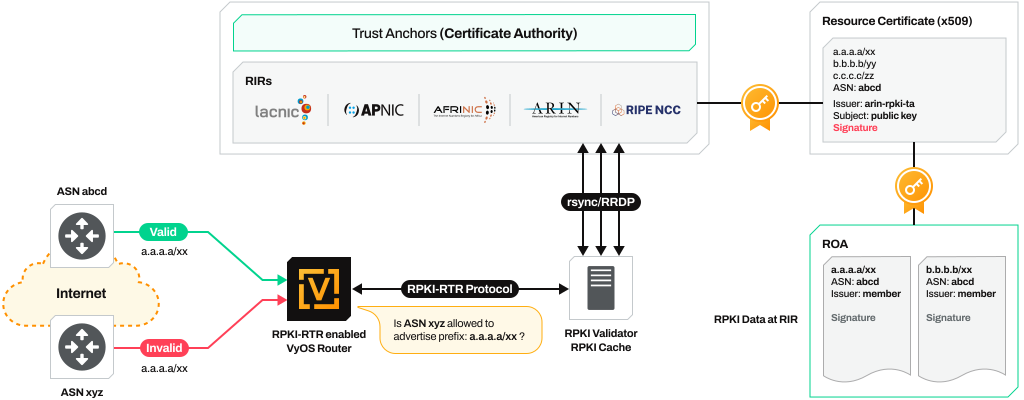
Certificate Authorities (CAs) issue digital certificates to IP address holders (e.g., RIRs like ARIN, RIPE).
Organizations generate ROAs, stating which AS is allowed to advertise each prefix.
Network operators deploy RPKI validators that fetch and verify ROAs.
BGP routers use the validation results to mark prefixes as:
Routing policies can then be enforced to prefer valid routes and reject or deprioritize invalid ones.
VyOS Resource Public Key Infrastructure
 Download Solution Brief
How does RPKI benefit organizations?

Protection
Protects IP address space from being hijacked or misused.

Security
Improves routing security, reducing the risk of traffic interception or blackholing due to incorrect BGP advertisements.

Credibility
Enhances trust and reputation, especially for ISPs, content providers, and enterprises with public-facing services.

Compliance
Helps comply with security best practices and industry expectations for BGP filtering and origin validation.
Summary of Key Components
How VyOS helps with RPKI
Here’s how it works with VyOS:
VyOS uses FRRouting (FRR) as its routing engine, which supports integration with external RPKI validators via the RTR (RPKI-to-Router) protocol (RFC 6810/6811).
Configure VyOS to connect to an RPKI validator, such as Routinator or rpki-client.
VyOS downloads validated ROAs via RTR over TCP.
BGP announcements received by VyOS are validated against ROAs.
Routing policy is applied to:


Want to learn more about VyOS Technical Capabilities?
Download the Technical Datasheet

 Technical Datasheet
Why VyOS?
Benefits of Using RPKI in VyOS:

Routing Security
Prevents acceptance of BGP routes from unauthorized or malicious sources.
Flexibility
Can be deployed on-prem, in the cloud, or at the edge.
Compliance & Best Practices
Aligns with MANRS (Mutually Agreed Norms for Routing Security) standards.
Open-Source & Cost-Effective
No licensing costs; full transparency and customization.
BGP Policy Control
Easily define route-maps and prefix-lists based on RPKI status.
Resources
Here are some resources to help you learn more about VyOS, keep up with the development, and participate in it.


