
Segment Routing with Traffic Engineering on VyOS




Introduction
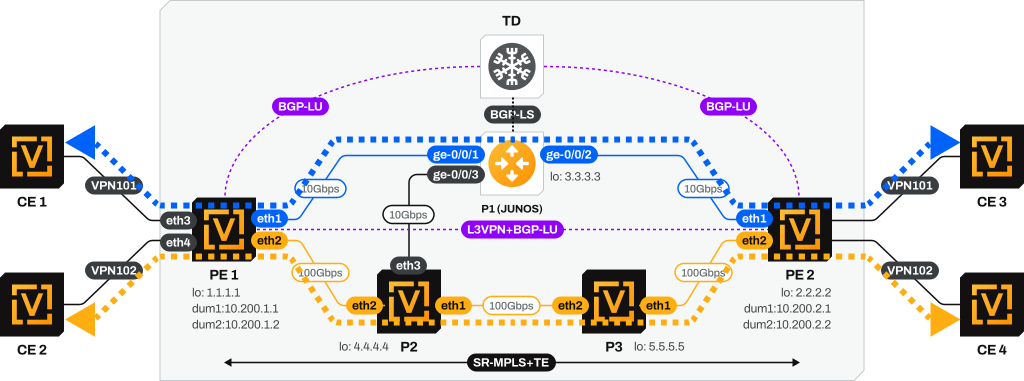
Deploying Segment Routing Traffic Engineering (SR-TE) on VyOS. VyOS supports modern traffic engineering architectures based on Segment Routing (SR), enabling deterministic path control without the signaling complexity of traditional RSVP-TE. SR-TE simplifies network design while improving scalability and operational efficiency.
Centralized SR-TE
In a centralized SR-TE model, path computation and segment list generation are handled by an external controller. VyOS routers act as enforcement points and are responsible for:
Advertising the IGP topology to the controller
Receiving computed SR-TE policies
Steering traffic into the appropriate SR-TE policies
Although centralized SR-TE is simpler than RSVP-TE, routers must support several key protocols and mechanisms, including:
BGP-LS for topology advertisement
BGP SR-TE or PCEP for receiving SR-TE policies
Automated traffic steering mechanisms
In this architecture, the external controller plays a critical role by defining traffic engineering policies and computing the paths that routers must follow. In our case, this functionality is provided by the Traffic Dictator, which is discussed in more detail later in this document.
Benefits of Using Segment Routing with Traffic Engineering on VyOS

Enterprise-Grade Routing Intelligence
With VyOS Segment Routing-TE, sophisticated traffic engineering, and broad multi-protocol support, VyOS provides powerful routing capabilities that exceed the limits of traditional cloud networking.

Path differentiation based on services
By combining traffic engineering with an intelligent controller capable of evaluating and selecting optimal paths, services can achieve enhanced redundancy and more advanced routing behavior

Automation-Ready
VyOS supports configuration via automation tools (Ansible, Terraform, Python) and integrates seamlessly with CI/CD pipelines, enabling consistent cloud deployments.

Full Control and Transparency
Unlike proprietary virtual routers, VyOS offers open configuration, logs, and routing visibility, ideal for troubleshooting and advanced network engineering.

Cost-Effective and Flexible
A lightweight universal router that scales elastically and easily, reducing licensing complexity while enabling enterprise-grade functionality.
Key Features
Segment Routing with Traffic Engineering on VyOS

L3VPN Secure
Layer 2 and Layer 3 VPNs for secure, scalable multi-tenant services.

Affinity and Constraints
Enable the selection of diverse and redundant paths based on link attributes and policy requirements.

Traffic and SR Policies
For deterministic application performance and optimized resource usage.

Reroute and Resiliency
Fast reroute and resiliency for high-availability service delivery.

Automation
Seamless automation through APIs and scripting, aligning with modern DevOps practices.
VyOS Segment Routing: Traffic Engineering using SDN Controller
 Download Solution Brief
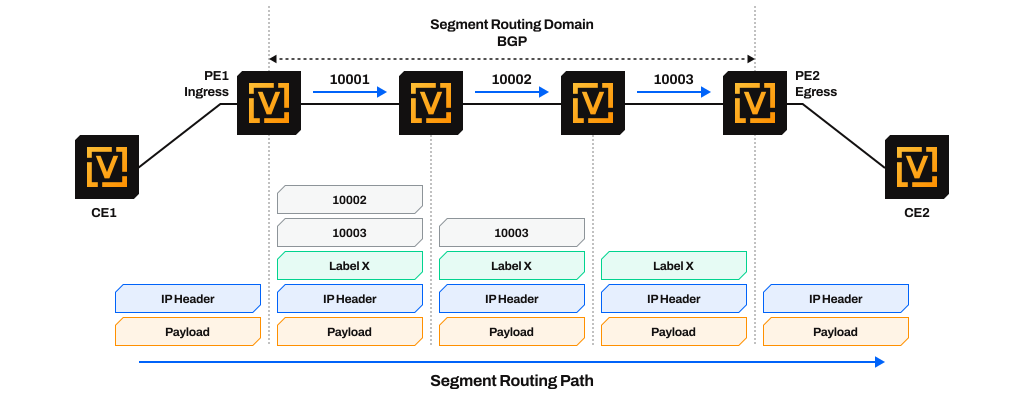
By deploying SR-MPLS with Traffic Engineering on VyOS, customers can design and instantiate advanced network services that require deterministic path control, redundancy, and bandwidth guarantees.
This architecture enables the creation of explicit, attribute-aware paths with bandwidth reservation and diverse routing characteristics, ensuring service continuity and optimized resource utilization.
Such capabilities are particularly valuable for mission-critical applications, high-demand services, and disaster recovery scenarios in modern, resilient network infrastructures.


Want to learn more about VyOS Technical Capabilities?
Download the Technical Datasheet

 Technical Datasheet
Resources
Here are some resources to help you learn more about VyOS, keep up with the development, and participate in it.


