
Modernizing IP Networks: The Case for SRv6




Introduction
As networks scale to support cloud services, IoT, 5G, and ultra-low latency applications, traditional architectures built on IPv4 and MPLS face growing limitations. These include operational complexity, rigid control plane dependencies, and challenges in service automation. The need for extensive protocol overlays (LDP, RSVP-TE, BGP, etc.) increases configuration overhead and limits agility.
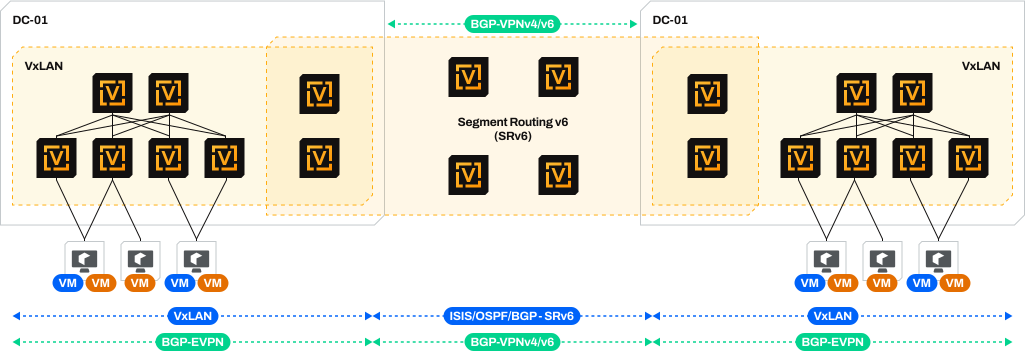
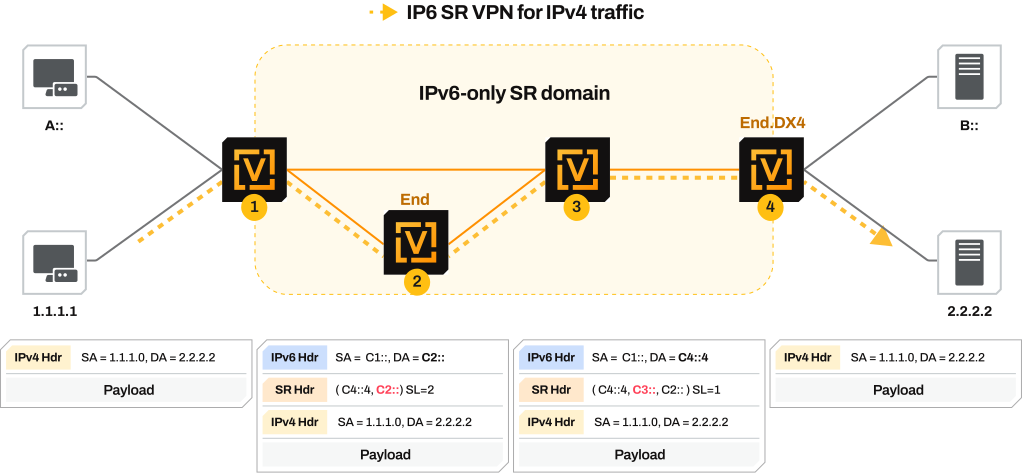
Segment Routing over IPv6 (SRv6) offers a modern, scalable alternative. By leveraging the source routing capabilities of IPv6, SRv6 eliminates the need for label distribution protocols and simplifies the forwarding plane. Each network instruction (segment) is encoded directly in the IPv6 header, enabling end-to-end programmability, finer traffic engineering, and service chaining without additional state in the network core.
Organizations migrating to SRv6 can expect
SRv6 is not just a routing enhancement—it's a foundation for future-proof network design.
Simplified architecture with fewer protocols to manage
Native support for SDN and network automation
Seamless integration with cloud-native and mobile environments
Enhanced scalability for large-scale deployments
What is Segment Routing over IPv6 (SRv6)?
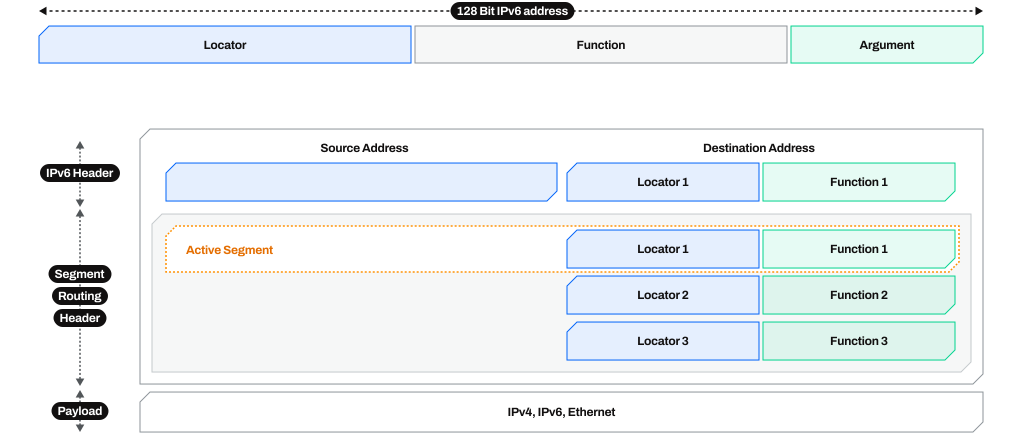
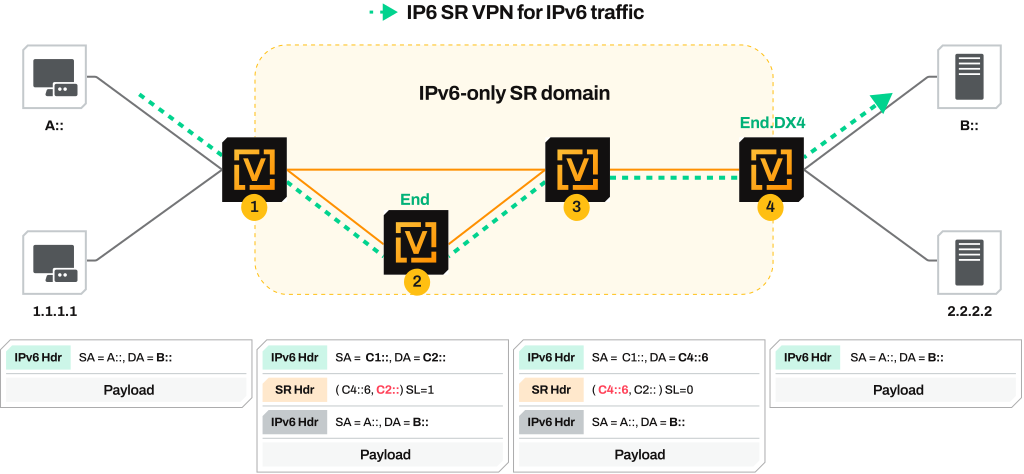
Segment Routing over IPv6 (SRv6) is a next-generation network architecture that embeds forwarding instructions—called segments—directly into the IPv6 packet header via the Segment Routing Header (SRH). These segments can represent topological paths, service functions, or specific network instructions, enabling fine-grained control without the need for maintaining state in the network core.
SRv6 removes the need for traditional MPLS control plane protocols (like LDP or RSVP-TE) and provides a unified data plane based solely on IPv6.
An important enhancement to SRv6 is the introduction of micro Segment Identifiers (uSID), a compressed format that allows multiple segments to be encoded within a single 128-bit IPv6 address. This significantly reduces overhead, improves scalability, and makes SRv6 more suitable for high-performance, dense deployments such as data centers and 5G networks.
Replace old hardware border routers with VyOS virtual solutions
 Download Solution Brief
Why Migrate to SRv6?
Benefits for Service Providers and Data Centers
Simplified Network Architecture
- Eliminates multiple legacy protocols (e.g., LDP, RSVP-TE).
- Stateless core; logic is encoded in the packet and processed at the edge.
Tunneling and MPLS
- uSID compresses multiple segments into a single IPv6 address, reducing header size.
- Enables support for long segment chains with minimal packet overhead.
Advanced Traffic Engineering
- Enables deterministic and flexible path control across large networks.
- Easily integrates with SDN controllers for centralized TE policies.
Native Service Function Chaining
- Supports precise chaining of network services (e.g., firewalls, NAT, DPI).
- No need for complex overlay mechanisms like NSH or GRE.
Cloud and 5G-Ready
- Aligns with modern application demands: low latency, programmability, and automation.
- Ideal for mobile backhaul, data center interconnect (DCI), and multi-cloud networking.
Automation and Cloud Integration
- Seamless fit for modern infrastructure: programmable, API-driven, and cloud-native.
Benefits of Deploying SRv6 with VyOS
VyOS, an open-source network operating system, provides a flexible and cost-effective platform for SRv6 deployments:
Open and Extensible
- Fully open-source, with no vendor lock-in.
- Supports customization for specific SRv6 use cases and integrations.
uSID Support and Flexibility
- Enables uSID encoding models for more efficient SRv6 deployments.
- Ideal for leaf-spine data center fabrics and metro network cores.
Advanced Traffic Engineering
- Enables deterministic and flexible path control across large networks.
- Easily integrates with SDN controllers for centralized TE policies.
Cloud and Bare-Metal Ready
- Can be deployed on virtual machines, containers, or physical hardware.
- Ideal for hybrid environments spanning cloud and on-premises infrastructure.
Automation-Friendly
- Rich CLI and API interfaces support modern automation tools (Ansible, Terraform, REST APIs).
- Enables intent-based networking and DevOps-driven infrastructure.
Cost-Sustainable
- Eliminates expensive licensing tied to traditional vendor hardware.
- Ideal for labs, pilots, or full-scale production environments with budget-conscious planning.
Community and Innovation
- Backed by a strong community and commercial support options.
- Continuous integration of new features like SRv6, EVPN, and modern routing protocols.
Transform Your Network with SRv6 and VyOS
Legacy MPLS architectures were built for yesterday’s challenges.
Today’s networks demand agility, simplicity, and scale—and SRv6 delivers exactly that.
With uSID and IPv6-native design, SRv6 enables programmable routing, efficient service chaining, and seamless integration with cloud and 5G ecosystems - without the overhead of traditional protocols.
VyOS gives you the freedom to deploy SRv6 your way—open-source, automation-friendly, and infrastructure-agnostic. No vendor lock-in. No hidden costs. Just powerful networking, wherever you need it.
Modernize your infrastructure. Simplify operations. Build for what’s next. Make the move from MPLS to SRv6—with VyOS at the core.


Want to learn more about VyOS Technical Capabilities?
Download the Technical Datasheet

 Technical Datasheet
Resources
Here are some resources to help you learn more about VyOS, keep up with the development, and participate in it.


